Tteokbokki Guide: Rice vs Wheat Cakes, Flavors and Instant Cups
Tteokbokki is easier to choose when you separate three things: the cake, the sauce and the way it is served. Rice cakes and wheat cakes can both appear in a red, spicy dish. Jjajang changes the sauce; rabokki adds noodles; a cup describes the packaging. None of these names alone tells you every ingredient or how spicy the finished meal will be.
This guide helps you read a menu, compare textures and choose an instant cup without assuming it cooks like cup ramen. Product examples illustrate the options; they are not a taste-test ranking.
Rice vs wheat tteokbokki: what changes?
Ssal-tteok (쌀떡) refers to rice-based cakes; mil-tteok (밀떡), in a tteokbokki menu, refers to wheat-based cakes. Although English menus often translate the dish as “spicy rice cakes,” that translation should not be treated as an ingredient declaration.
| What to compare | Rice-based cakes | Wheat-based cakes |
|---|---|---|
| Main ingredient to look for | 쌀 or 쌀가루: rice or rice flour | 밀 or 밀가루: wheat or wheat flour |
| Useful texture description | Often described as dense and chewy, with a substantial bite | Often described as soft, supple and chewy |
| What those words cannot prove | Not every rice cake is firmer than every wheat cake | Softness does not identify wheat with certainty |
| Shapes | Can include short sticks, thick cuts and other shapes | Can include short sticks and long, noodle-like shapes |
| Reliable confirmation | Read the cake’s ingredient list or ask the seller | Read the cake’s ingredient list or ask the seller |
Both can be chewy. The practical difference is the kind of bite you prefer, not a universal winner. For example, Pulmuone describes its noodle-shaped wheat cakes as soft and chewy and its round rice cakes as having a compact, chewy texture. Its manufacturing information also describes extrusion and added ingredients used to change texture. These are specific product descriptions, not controlled comparisons of every rice and wheat cake.
Thickness, recipe, manufacturing and preparation all matter. A long, flat cake and a thick cylinder may feel very different even when their main grain is the same. Compare products prepared according to their own instructions rather than judging an underheated or overcooked example as representative of the entire category.
How to tell rice cakes from wheat cakes
- Check the menu or front label. Look for 쌀떡, 밀떡 or an explicit rice/wheat description.
- Read 원재료명, the ingredient list. For a kit, distinguish the cake ingredients from the sauce, noodles and toppings.
- Ask when buying a prepared portion. “쌀떡인가요, 밀떡인가요?” means “Are these rice cakes or wheat cakes?”
- Do not use shape or color as proof. A thick white cake is not an ingredient certificate, and sauce can hide its appearance.
If a label lists several grains or starches, describe the actual blend instead of forcing the product into a “100% rice” category. Likewise, “contains wheat” on a complete kit may refer to the sauce or noodles rather than the cake itself.
Rice-based cakes do not automatically make the whole dish gluten-free. One concrete example is Dongwon’s jjajang tteokbokki: the listed cake uses rice, while the sauce ingredients include wheat. For a dietary restriction, check every component and the manufacturer’s allergen information; at a stall, ask about the complete dish rather than only the cake.
Tteokbokki flavors: red, jjajang, rosé and more
The Korea Tourism Organization describes the familiar red version using chili paste and vegetables, and describes royal-style tteokbokki with soy sauce, beef, mushrooms and vegetables. Modern menus add other sauce families. Dookki’s official ingredient list, for example, includes jjajang, rosé, cream, royal-style, mala and curry options.
| Style | What to expect | What to check |
|---|---|---|
| Classic red / 일반 떡볶이 | A chili-based, sweet-savory direction; recipes differ | Ask about heat rather than judging the color |
| Jjajang / 짜장 | A dark, savory sauce based on Korean-style black bean paste | Some products are designed to be non-spicy; others include chili |
| Gungjung / 궁중 | Royal-style, soy-sauce-based preparation, traditionally with beef and vegetables | Confirm the actual ingredients; it is not automatically vegetarian |
| Rosé / 로제 | A creamy-style option commonly paired with a spicy base | Confirm heat and dairy ingredients; do not assume tomato-pasta sauce |
| Cream / 크림 | A richer, creamy sauce direction | Check whether chili or other spicy ingredients are added |
| Cheese / 치즈 | Cheese flavor in the sauce or cheese added on top | Ask which one; the underlying sauce may still be hot |
| Mala / 마라 | A spice-forward style that can include a numbing sensation | Heat and numbing intensity depend on the recipe |
| Curry / 카레 | Curry-seasoned sauce, sometimes combined with a spicy base | Check the particular recipe instead of assuming a mild curry |
For a low-heat starting point, look for a product explicitly labeled non-spicy or ask about a soy-based version. Pulmuone’s published description of its jjajang product says that particular recipe was designed without heat. That does not establish a rule for all jjajang tteokbokki: the Dongwon example lists chili among its sauce ingredients.
Rabokki and soup-style tteokbokki are different kinds of labels
Rabokki (라볶이) combines tteokbokki with ramen-style noodles. It can still have a red, cheese or another sauce. Choose it when you want both noodles and cakes, then check the serving size rather than assuming it is a small snack.
Gungmul tteokbokki (국물떡볶이) indicates a soupier preparation. It describes the amount or style of sauce, not whether the cakes use rice or wheat. Jeukseok tteokbokki (즉석떡볶이) commonly refers to a restaurant version cooked in a pan at the table with your chosen ingredients. Here, “jeukseok” should not be confused with a packaged instant cup.
A street stall may also serve already-cooked tteokbokki in a disposable cup. That is different from a sealed retail cup containing separately packed cakes and sauce that still need cooking.
Instant cup tteokbokki: what kinds are available?
Cup products are convenient only if you have the equipment they require. A cup-shaped package does not mean “add boiling water and wait.” The manufacturer-submitted Yopokki information on RICESHOW describes microwave preparation for its cups and pan preparation for its pouches.
| Product family | Examples documented by the brand or exhibitor | Buying check |
|---|---|---|
| Yopokki cup tteokbokki | Sweet-and-spicy, cheese, hot-and-spicy and jjajang are among the documented flavors | Confirm the exact flavor, pack format and microwave instructions |
| Yopokki cup rabokki | Sweet-and-spicy, cheese, hot and kimchi examples | Contains noodles as well as cakes; follow its own water and heating instructions |
| Samyang Buldak tteokbokki | A hot Buldak-sauce version; a separate Carbo Buldak product is also listed by the official store | Do not equate a creamy flavor name with non-spicy food |
| Pouch or pan-cook kits | Cakes and sauce packaged for preparation in cookware | Check required equipment, serving count and storage conditions |
These are examples of documented products, not a promise that every convenience store stocks them. Domestic and export packs can differ, and older catalogs may show different weights or flavors. Use the package in front of you for current ingredients, nutrition and cooking directions.
A practical five-point check before buying a cup
- Equipment: look for 전자레인지, meaning microwave. If you only have a hotel kettle, do not assume it is suitable.
- Water: follow the stated amount or fill line, including whether the instructions specify hot or cold water.
- Packets and lid: remove packaging or non-food sachets as directed and follow the lid instructions.
- Power and time: use the timing for your microwave’s wattage. Do not copy another flavor’s instructions.
- Storage: distinguish shelf-stable, refrigerated and frozen products. The storage claim for one brand or pack does not apply to all cups.
Do not judge value by package size alone. Compare the number of servings and what is included: cakes only, cakes plus noodles, or a kit with toppings. Nutrition figures should also be compared on the same basis—per serving or per whole pack.
Korean words and questions worth saving
| Korean | Meaning or use |
|---|---|
| 쌀떡인가요, 밀떡인가요? | Are these rice cakes or wheat cakes? |
| 많이 매운가요? | Is it very spicy? |
| 안 매운 메뉴가 있나요? | Do you have a non-spicy option? |
| 치즈가 들어가나요? | Does it contain cheese? |
| 전자레인지가 필요한가요? | Does this require a microwave? |
| 원재료명 / 조리방법 | Ingredients / cooking instructions |
| 실온보관 / 냉장보관 / 냉동보관 | Room-temperature / refrigerated / frozen storage |
For broader menu, portion and payment questions, see how to order at a Korean restaurant.
Which one should you try first?
- You want the familiar street-food style: choose a red version, then ask about spice level and cake type.
- Texture is your priority: compare a clearly labeled rice-cake version with a wheat-cake version. Similar sauces make the cake difference easier to notice.
- You prefer less heat: choose an explicitly non-spicy recipe rather than relying on “jjajang,” “cheese” or “cream” alone.
- You want a hotel-room snack: confirm the cooking equipment and storage instructions before choosing a cup.
- You want both cakes and noodles: look for rabokki and check whether the portion suits one person or sharing.
Sources and how this guide was checked
Reviewed November 12, 2026. Cultural descriptions use Korea Tourism Organization material; product examples use official manufacturer pages and manufacturer-submitted exhibition listings. Texture descriptions are attributed product characteristics, not results of our own tasting or laboratory testing. No universal visual test for identifying rice versus wheat cakes is claimed.
- Korea Tourism Organization: Tteokbokki and Royal Tteokbokki.
- Pulmuone: rice and wheat tteokbokki manufacturing; noodle-shaped wheat cakes; round rice-cake product.
- Pulmuone: jjajang tteokbokki and Dongwon: jjajang product ingredient information.
- Dookki: official sauce and ingredient list. Availability varies by branch.
- RICESHOW: Youngpoong Yopokki and Yopokki cup rabokki.
- Samyang: Buldak tteokbokki and Carbo Buldak tteokbokki.
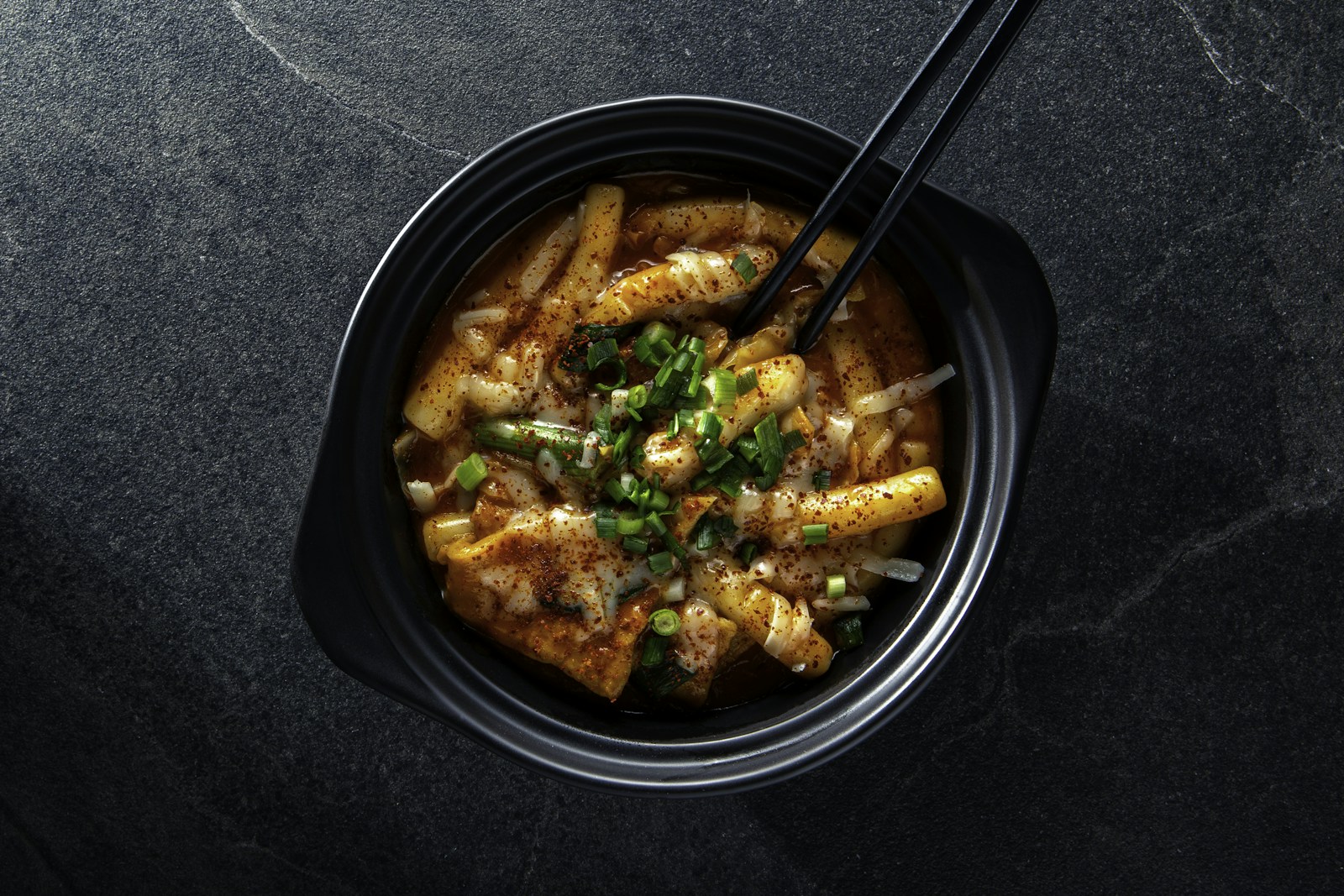
Cover photograph: Marcin Skalij / Unsplash. Illustrative prepared tteokbokki; the photograph does not identify its cake ingredients or depict a reviewed packaged product.